I love this little park, Pioneer Square. To be truthful, I have never got out and walked through it. However, I have driven through it at all times of day and night. I have been stopped by floods of pedestrians spilling out of the square into the streets. One of the first times I was drove through was in the evening, and I wasn't even sure if I was driving on the road or if I had entered a pedestrian only plaza. This is one of Seattle's iconic treasures.
Tuesday, August 14, 2007
Pioneer Square Seattle
I love this little park, Pioneer Square. To be truthful, I have never got out and walked through it. However, I have driven through it at all times of day and night. I have been stopped by floods of pedestrians spilling out of the square into the streets. One of the first times I was drove through was in the evening, and I wasn't even sure if I was driving on the road or if I had entered a pedestrian only plaza. This is one of Seattle's iconic treasures.
Monday, August 13, 2007
Garden Arbor
I know it is very cliche, but the first sketches were drawn on a napkin over breakfast. You have to strike while the iron is hot! I then come home with napkin in tow and put initial idea to 3d sketchup, after I researched a little more Pacific Northwest and Asian Architecture. I really wanted to use bamboo, and my initial plan was to use bamboo as the top. I was going to make indentions for timber bamboo to set in with bolts so they could be drilled and fastened in place. They would need replaced periodically, but the climate is so dry in eastern Washington that bamboo lasts much longer than you would expect. Timber bamboo is relatively inexpensive too. The customer wanted something more permanent. She loves rusty steel and concrete. A steel trellis was to go in the center for climbing plants, but after the construction, the customer may leave it as is. The entire arbor is to hold a fir limb up off the ground and out of the way of the path. A rose and clematis may grace the sides. I think the scale of the piece in the garden is lovely. I got to pour the foundation, but was not present to form the main structure and cross pieces. Yes, those cross pieces are concrete. The report was the customer was extremely pleased with the whole piece. It is very gratifying seeing work go from a concept and drawing to a built structure.


My Sketchup Model I presented to the customer, along with other drawings.
The fir has already found its home on the top of the arbor.
5" steel pipe cut to length, and 10" concrete columns.
Because the garden path is curved the arbor has a slight curve. I expected a little bit more fan in the overhead pipe, but the difference in distance apart were swallowed up by the scale of the pipe and its length.

The customer has a beautiful garden that I helped design in its early stages. It is a true garden that has evolved and matured at the caring hand of its owner.
The fir has already found its home on the top of the arbor.
5" steel pipe cut to length, and 10" concrete columns.
Because the garden path is curved the arbor has a slight curve. I expected a little bit more fan in the overhead pipe, but the difference in distance apart were swallowed up by the scale of the pipe and its length.
The customer has a beautiful garden that I helped design in its early stages. It is a true garden that has evolved and matured at the caring hand of its owner.
Tuesday, August 7, 2007
Summer Work Continues
It has been an amazing summer for me. With each plan I learn how to better express my ideas. My ideas are generated by the client and how I think they will be using the space. Ultimately it is about the customer! My ego is about how happy the customer is in the end. Of course I get to insert my notions of professionalism. I believe it is irresponsible to not pay attention to such issues as water use, water runoff, safety and environmental issues.


Monday, August 6, 2007
Seattle's Olympic Sculpture Park
My first introduction to Seattle's Olympic Sculpture Park was newspaper clippings from the Sunday edition of the PI and Seattle Times. They arrived in an envelope from home. obviously my schooling and chosen career spurred the rare arrival of news clippings from home.
So it landed on my list of must-see places on my next visit to the Evergreen State.
SAM--Seattle's Olympic Sculpture Park
This park was very inspirational as a student of Landscape Architecture. It is brand-new and it feels that way. As a student I get an immediate comprehension of the rhythm and sequence of the spaces. It is still severe in places, and that will change as the plant material matures.
Headed towards the beach
This little guy had wrecked his scooter going down the gravel paths. His mother was at the bottom. It was not the first time he had wrecked by the looks of his knees. He got back up and headed back down. I think his mother was more concerned about the long term affects of the boys knees as they were being wore off by the gravel. He was having a ball though.
This really was my favorite part of the park. When I entered, it is just a small little beach, dwarfed by the large expanse of the Sound. It is actually a substantial size beach with room for many to have private play spaces and not overwhelm the feelings of the beach. The Olympic Mountains are in the distance, the Port of Seattle to the left and a group of cottonwood shield the line of site to the right. It is this cottonwood grouping and the Olympic Mountains in the distance that create a sense of wilderness and nature. On this beach, I was no longer in Seattle, but I was in a decade and era that still had wilderness when you walked up to the Sound. Part of this feeling of awe, might be inspired by the very lack of beach access. It is very nicely done, and it has to be a favorite spot of many. If I am back in the winter, I am going to get back to this little spot. I love the Sound and the water with the chill of Winter and all its cool and tempestuous moods.
I appreciate art, I'm not what you would call a connoisseur. Art moves me and I enjoy analyzing the feelings a piece of art invokes. This piece of art, "Wake" by Richard Serra requires that you walk up and touch it, and to my dismay there is a security guard sitting in the shade with signs that say "Do Not Touch " . However, it did strike up a dialogue with the security guard on the iniquities involved in not being able to experience the "Wake" with the sense of touch.

Richard Serra "Vortex" Modern Art Museum of Fort Worth
I was first introduced to Serra in Fort Worth. His work is beautiful. His work pulls at your sense of place, almost like gravity with a different down.
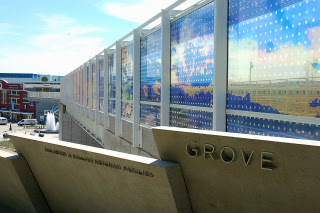
It is not just the park, there are outside contextual elements that have a relationship with the park. (whether you want them to or not.)
City and nature, at the large scale. Urban materials and plants at the small scale. This is an eye catching piece full of movement and reflection.
"Please Sir, let me run my hands along these gentle curves." I just wanted to put my face up against this sensual piece.
Truly a beautiful piece of art.
The Landscape Architect plays as much of a role in the expression of this piece as the actual piece. A lesson in collaboration I hope.
It is a piece of art itself and it is the counter balance or resting place of the "Wake"
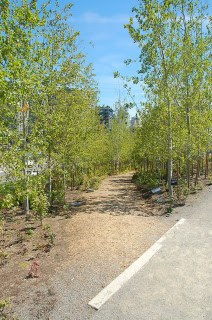
Aspen planted rigidly in rows. It will be interesting to see how they maintain this grove. Aspen seem the most unlikely tree to stay rigid and confined.
This is one of the more successful spaces in my view. Simple red chairs that echo the "Eagle" set out in condominium style on the edge of the Sound. This is your opportunity to be a citizen of the Pacific Northwest and take ownership in such a grand place. It is your personal patio.
I'm sure I'll be back to visit. It was a pleasure. Thank-you SAM!
jlw

Airport distress
It is interesting and a bit ironic that I find myself sitting in an airport stranded for the third time in only 9 weeks. The first was a canceled flight to Denver due to high winds and the second a canceled flight to Phoenix because of flooding. Actually, technically I am not stranded, I am waiting on Kerri who is delayed, but thankfully in route, out of Chicago due to severe thunderstorms. Technically I can't say that I was ever stranded as much as I felt hostage to the airlines. It reminds me of my reading of F. L. Olmsted in his journeys of the prewar South.
The Ironic part is the trio of books I have read due to the modern marvel of air transportation:


"A Clearing in the Distance" by Witold Rybczynski
One of my favorite parts of "A Clearing in the Distance" is where Olmsted is traveling the South:
Olmsted continues on the woes of traveling in the South. Not much has changed in human character and our traveling predicaments. The transportation and hospitality industry has the traveler over a barrel. The airlines are finally starting to turn a profit, and it is at the expense of the passenger. What other company makes its most profits at the discomfort and inconvenience of the customer? Is it the fault of the airlines when bad weather cancels or delays a flight? No. However, not having a contingency plan for the customer is their fault. It seems the less contingency plans made, the higher the profits. Like the stranded of Denver this winter, if you are bumped, you are bumped into a dark hole at the mercy of the airlines where there is very little mercy to be found these days. The standard accepted practice is to cause a commotion and demand which only steels the airlines defences and jades the people behind the counter. I have never experienced such horrible customer service as our air transportation. Traveling has devolved into a shove and scratch mentality. The common traveler has amazing resilience, but the airline employee has been denuded of patience and compassion. I saw an airline ticket agent yell and scream at a group of passengers that were standing in hopes to get on an outbound plane. "SIT DOWN!" and when they didn't she hollered it again and demanded they sit and wait. It was the most uncomfortable feeling as I was being ushered past them by another airline agent because of my canceled flight. Prepare yourself if you fly. It will feel like antebellum South out there.
Where Olmsted peaks in the second half of the 1800s, 1491 is about pre-European settlement of the Americas.
I have been struggling, philosophically about my footprint and the footprint of my designs. Oklahoma, in my mind, has always been this grand prairie system independent of man's hand. I would not say that 1491 by Charles C. Mann flipped my way of thinking, but it helped clarify my design motives and intents. Man has a much longer and deeper connection with Oklahoma than I had previously believed. Man probably has a prehistoric connection with the great plains that is uncelebrated.
A more broad and regional approach to land management should be applied. Man is part of the equation, and regional aesthetics are still a founding principle in direction, preservation and appreciation of landscape.
My final airport read is Scott W. Berg's "Grand Avenues". It is the story of L'Enfant, the designer of Washington D.C.. As a designer it is a very passionate story of grand design, betrayal and emotional vindication. Berg does a fine job of needling out politics of the day. It turned my imaginations of esteemed men upside down and in different light. Thomas Jefferson in particular. In the end Rick Olmsted jr. son of the first American landscape architect sees the vision of L'Enfant and has the ability with the help of others to pull the vision of L'Enfant out of quagmire. Like most Landscape Architecture projects, designs are polluted with the limiting factors of finances and politics. Truly landscape architecture is the art of a sale, the persuasive powers to get finances and the enduring quality of the design.
Daniel Burnam wrote:
With these three books I reflect on the direction and plodding of history. I wonder as I wait for Kerri's plane if our transportation grid of the sky is doomed? Should we have invested more on high speed rail? Am I doing a disservice to my clients by not presenting what their little piece of land is capable of? Of the three books one of the major influence is transportation. I find it ironic that I sit, wait and ramble like so many before me who have traveled.
The Ironic part is the trio of books I have read due to the modern marvel of air transportation:


"A Clearing in the Distance" by Witold Rybczynski
One of my favorite parts of "A Clearing in the Distance" is where Olmsted is traveling the South:
In Norfolk, he found that the only good hotel had been closed down due to insufficient business, and when he did find a room, there was rainwater from a leaky roof puddling on the floor, and no fireplace. t was January, and he was so cold and damp that he was obliged to go down to the warm but smoke-filled and stinking public bar. He sat in a corner and listened to the landlord and his drunken cronies complaining loudly and obscenely about the infidel abolitionists, chif among them the author of "Uncle Tom's Cabin!"
The next morning, as he was abuot to have breakfast, he was told he would have to leave immediately or he would miss his train. He suspected he was being cheated since he had already been charged for the meal--this had happened to him once before. Nevertheless, he hurried to catch the ferry across the river to the railroad station. He and the porter carrying his luggage arrived at the dock just in time to see the stern o fthe departing boat. There was nothing to be done, so he bought some food from a market stall and sat down to wait. Twenty minutes later the ferry returned. His anxiety about missing th train--and having to spend another twenty-four hours in that dismal hotel--was aggravated when, halfway across the river, the paddleboat began to drift with the current because the stoker had gone to sleep. Finally, they arrived at the railroad station, a full half hour late. The train had not left; indeed, the ticket office was not even open. It was another hour before they pulled out of the station.
Olmsted continues on the woes of traveling in the South. Not much has changed in human character and our traveling predicaments. The transportation and hospitality industry has the traveler over a barrel. The airlines are finally starting to turn a profit, and it is at the expense of the passenger. What other company makes its most profits at the discomfort and inconvenience of the customer? Is it the fault of the airlines when bad weather cancels or delays a flight? No. However, not having a contingency plan for the customer is their fault. It seems the less contingency plans made, the higher the profits. Like the stranded of Denver this winter, if you are bumped, you are bumped into a dark hole at the mercy of the airlines where there is very little mercy to be found these days. The standard accepted practice is to cause a commotion and demand which only steels the airlines defences and jades the people behind the counter. I have never experienced such horrible customer service as our air transportation. Traveling has devolved into a shove and scratch mentality. The common traveler has amazing resilience, but the airline employee has been denuded of patience and compassion. I saw an airline ticket agent yell and scream at a group of passengers that were standing in hopes to get on an outbound plane. "SIT DOWN!" and when they didn't she hollered it again and demanded they sit and wait. It was the most uncomfortable feeling as I was being ushered past them by another airline agent because of my canceled flight. Prepare yourself if you fly. It will feel like antebellum South out there.
Where Olmsted peaks in the second half of the 1800s, 1491 is about pre-European settlement of the Americas.
I have been struggling, philosophically about my footprint and the footprint of my designs. Oklahoma, in my mind, has always been this grand prairie system independent of man's hand. I would not say that 1491 by Charles C. Mann flipped my way of thinking, but it helped clarify my design motives and intents. Man has a much longer and deeper connection with Oklahoma than I had previously believed. Man probably has a prehistoric connection with the great plains that is uncelebrated.
A more broad and regional approach to land management should be applied. Man is part of the equation, and regional aesthetics are still a founding principle in direction, preservation and appreciation of landscape.
My final airport read is Scott W. Berg's "Grand Avenues". It is the story of L'Enfant, the designer of Washington D.C.. As a designer it is a very passionate story of grand design, betrayal and emotional vindication. Berg does a fine job of needling out politics of the day. It turned my imaginations of esteemed men upside down and in different light. Thomas Jefferson in particular. In the end Rick Olmsted jr. son of the first American landscape architect sees the vision of L'Enfant and has the ability with the help of others to pull the vision of L'Enfant out of quagmire. Like most Landscape Architecture projects, designs are polluted with the limiting factors of finances and politics. Truly landscape architecture is the art of a sale, the persuasive powers to get finances and the enduring quality of the design.
Daniel Burnam wrote:
Make no little plans; they have no magic to stir men's blood and probably themselves will not be realized. Make big plans; aim high in hope and work, remembering that a noble, logical diagram once recorded will never die, but long after we are gone will be a living thing asserting itself with ever growing insistency. Remember that our sons and grandsons are going to do things that would stagger us. Let your watchword be order and your beacon be beauty.
With these three books I reflect on the direction and plodding of history. I wonder as I wait for Kerri's plane if our transportation grid of the sky is doomed? Should we have invested more on high speed rail? Am I doing a disservice to my clients by not presenting what their little piece of land is capable of? Of the three books one of the major influence is transportation. I find it ironic that I sit, wait and ramble like so many before me who have traveled.
Friday, August 3, 2007
Seattle Space Needle
The Space Needle is truly a beautiful park. I always get this sentimental sense of history and of the World's Fair. I do enjoy the progressive additions, like Frank Gehry's work. The kids and I visited on the hottest day of the year for Seattle, it was 102 degrees. It was also midweek, but the park still had plenty of traffic. I like this park because of the vignettes and views that are unexpected and yet surely staged. It is possible to find private space or the hustle and bustle of the Needle itself. It is really a park complex, and it has plenty of attractions for all.
At the fairgrounds in Oklahoma City, there is a view tower that is a fun ride. However, it doesn't have the style and elegance of the Space Needle. I have been to the 35th floor of one of the towers downtown OKC, and it is an experience that should be more available and accessible by the general public. OKC should consider a lookout tower in their new Core-to-Shore planning. Getting a view of the prairie is so rare simply because of the topography. It is a very intense experience to get up where you can see the world.
Subscribe to:
Posts (Atom)